
My vote is for non-ai. Look at those rocking chairs. They actually make sense. Even the best image models would trip up on complex geometry like that. Also the window on the top right. You can see through to the window on the opposite side of the cabin and see some of the green foliage through it. It looks very “abrupt” in the sense that I don’t think that a model trying to come up with the most statistically likely image would just put a fragment of green in the window like that.
- 3 Posts
- 12 Comments
Joined 2 years ago
Cake day: December 28th, 2023
You are not logged in. If you use a Fediverse account that is able to follow users, you can follow this user.
Speak for yourself, carbon lifeform
( /j )

 342·5 months ago
Jesus christ people in the comments here are pathetic. This clearly has nothing to do with racial slurs or otaku culture. It’s a play on the totally normal english word “tycoon” which just means “very rich businessman” and “mogul” which is a synonym for “magnate”. You can look these up, every half-decent dictionary has these words. They probably changed it because “coon” is a slur for black people and they didn’t want to cause any misunderstandings. If any of this offends you, please, please just step outside, touch some grass, take a deep breath, relax.
 1·9 months ago
Yeah this is the way. Debian stable has outdated packages, debian testing has broken packages. Ubuntu is difficult for beginners because of snap. Linux mint is the perfect just-works debian-based beginner distro. Same for DE: Gnome is hard to use, KDE is bloated and unstable, and XFCE is too minimalist/diy/quirky for beginner users (you need to add a panel applet in order for the volume keys to work? Huh??). Cinnamon is the perfect middle ground between resource usage and features.
Make sure during installation that you create a 4 GB swap partition too
Or at least as large as your RAM if you want to be able to hibernate.
 31·9 months ago
“The fuck else were these people expecting” is also my visceral reaction whenever shit like that happens, but if I think about for a bit longer, I realize that it’s not much different than saying “The fuck else were you expecting” to a rape victim who went alone into a dark alley. Sure, people are stupid for engaging with this obvious scam, but the bad guy is still the scammer, not the victims.


If GRUB is too confusing, just uninstall it? You said you have a UEFI system, you don’t need a bootloader. You can just put the vmlinuz and initramfs onto the ESP and boot into it directly. You can use
efibootmgrto create the boot entry, something like this:efibootmgr \ --create \ --disk /dev/sda \ --part 1 \ --index 0 \ --label "Void linux" \ --loader /vmlinuz-6.6.52_1 \ --unicode " \ root=PARTLABEL=VOID_ROOT \ rw \ initrd=\\initramfs-6.6.52_1.img \ loglevel=4 \ net.ifnames=0 \ biosdevname=0 \ nowatchdog \ iomem=relaxed \ "--disk /dev/sda: What disk is the esp on?--part 1What partition number (counting from 1) is the esp on?--index 0At what index in the boot menu should the boot entry appear?--loaderPath to thevmlinuzfile. These are normally in /boot, you have to move it to the esp yourselfroot=PARTLABEL=VOID_ROOTthis is the linux root partiion. I’m using PARTLABEL to identify mine, but you can use pretty much anything that /etc/fstab supportsinitrd=\\initramfs-6.6.52_1.imgAgain, you have to move the initramfs file from /boot into the esp. For some reason this uses backslashes, not forward slashes as path separator (double backslashes in this case are to prevent the shell from interpreting it as an escape sequence)- The rest of the arguments are just misc kernel parameters that I use
Just search for
EFISTUBfor more info.
Yeah, and it did become the next big thing. So much so that we’re still trying to figure out how to escape the overreaching grasp of big data algorithms that control social media networks.


A technology that was made To Stop Criminals™ being used against a political whistleblower? Color me surprised! (thanks for sharing the link btw, didn’t know about that)

modular daemons
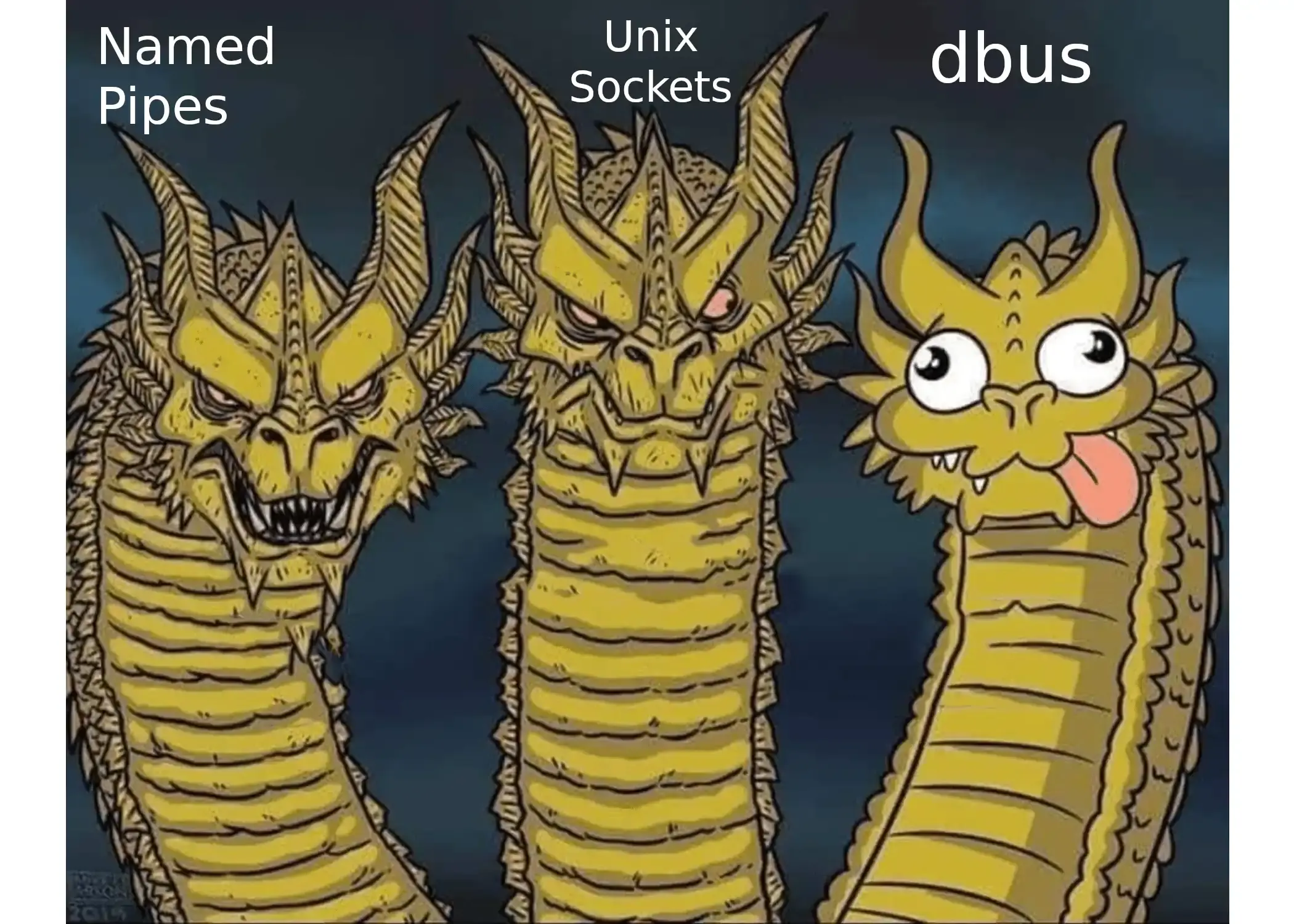
A message bus won’t magically remove the need for developers to sit down together and agree on how some API would work. And not having a message bus also doesn’t magically prevent you from allowing for alternative implementations. Pipewire is an alternative implementation of pulseaudio, and neither of those rely on dbus (pulse can optionally use dbus, but not for its core features). When using dbus, developers have to agree on which path the service owns and which methods it exposes. When using unix sockets, they have to agree where the socket lives and what data format it uses. It’s all the same.
It can even start the receiving daemon if it is not yet running.
We have a tool for that, it’s called an init system. Init systems offer a large degree of control over daemons (centralized logging? making sure things are started in the correct order? letting the user disable and enable different daemons?). Dbus’ autostart mechanism is a poor substitute. Want to run daemons per-user instead of as root? Many init systems let you do that too (I know systemd and runit do).
Forgejo is an activitypub-enabled Git forge software, and codeberg is one of the largest forgejo instances.
Tangentially related, but git-annex, and, in particular, its sync subcommand are a great tool for storing files and managing git repos across multiple machines (and even just loose drives) in a “P2P” way without any centralised server